
What impact did Harold Richardson have on mento music?
Uncover the lasting impact of Harold Richardson on mento music. Explore how his recordings, vocal style, and storytelling helped preserve Jamaican folk culture and influenced the foundation of reggae, ska, and dancehall.
While names like Lord Flea and Count Lasher often headline the early history of Jamaican music, Harold Richardson played a quieter, yet equally foundational role in shaping mento. As one of the first mento artists to be professionally recorded, Richardson helped define how the genre would be understood, preserved, and later transmitted into the DNA of ska, reggae, and dancehall. His impact is both musical and cultural — felt in his voice, his timing, and the way he made rural Jamaican life resonate on record.
This article examines the cultural, sonic, and archival influence of Harold Richardson on the legacy of mento music.
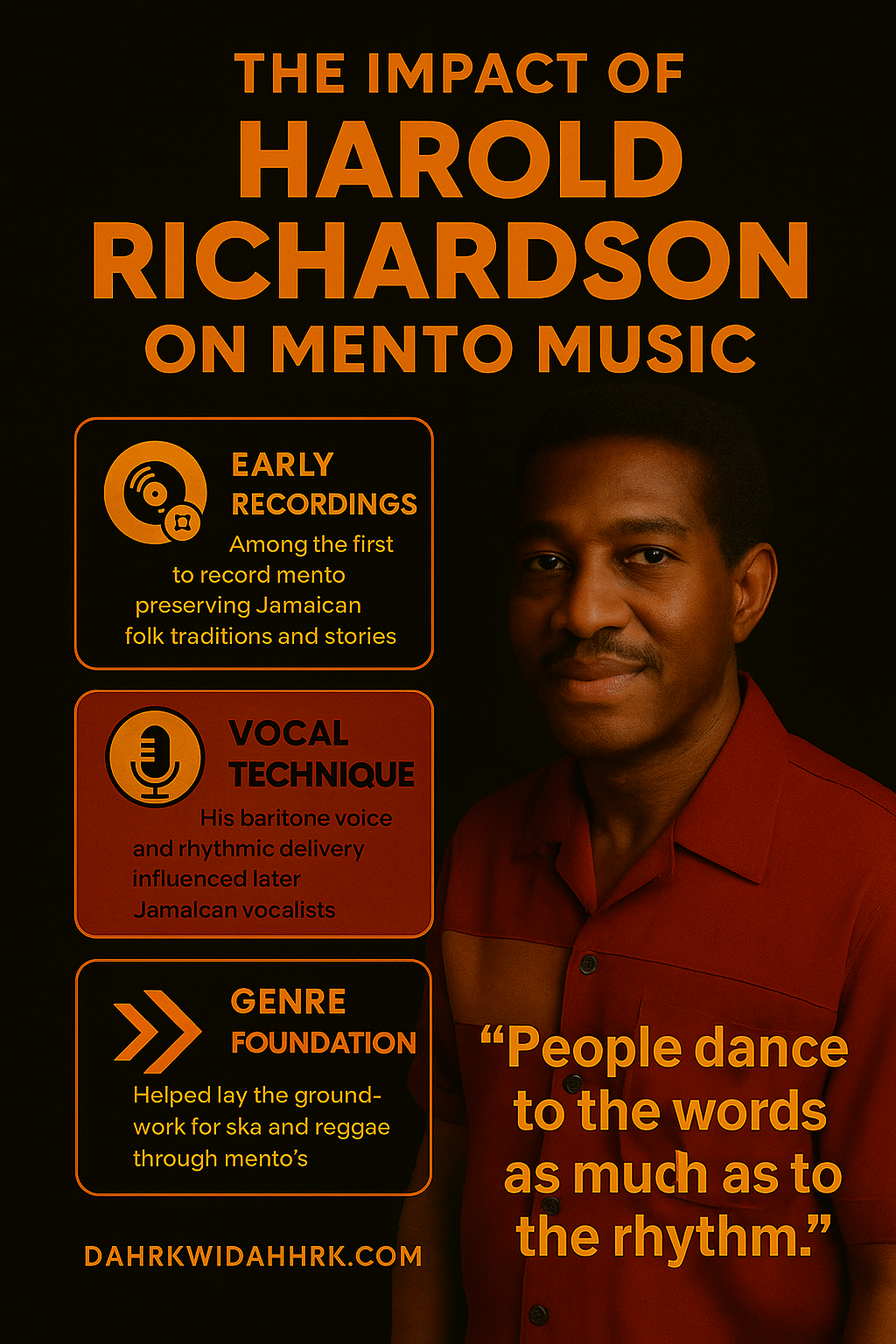
1. Documenting Mento’s Early Voice
Harold Richardson’s biggest impact was helping cement mento’s presence in recorded form. At a time when most folk traditions were passed down orally or performed in informal settings, Richardson’s sessions with Motta’s Recording Studio (MRS) ensured that the sound of early-1950s Jamaica was captured and preserved.
His recordings:
- Gave voice to working-class narratives
- Captured authentic Jamaican patois and idioms
- Preserved song forms rooted in African oral storytelling
“His voice became the bridge between the market and the music archive — a carrier of community knowledge.” — Manuel, 2006
Through songs like Run Mongoose Run and Slide Mongoose Slide, Richardson did not just perform mento — he canonized it.
2. Influencing Vocal Style and Lyrical Technique
Richardson’s baritone clarity, rhythmic delivery, and punchy phrasing became a stylistic model for other mento singers. His recordings stand out for their:
- Conversational delivery, reminiscent of griot-style oral narration
- Comedic timing, using wordplay and punchlines rooted in Jamaican social life
- Double entendre, a lyrical trait that would later flourish in dancehall
These elements were not just entertainment tools — they were cultural devices that communicated meaning, humor, critique, and resilience.
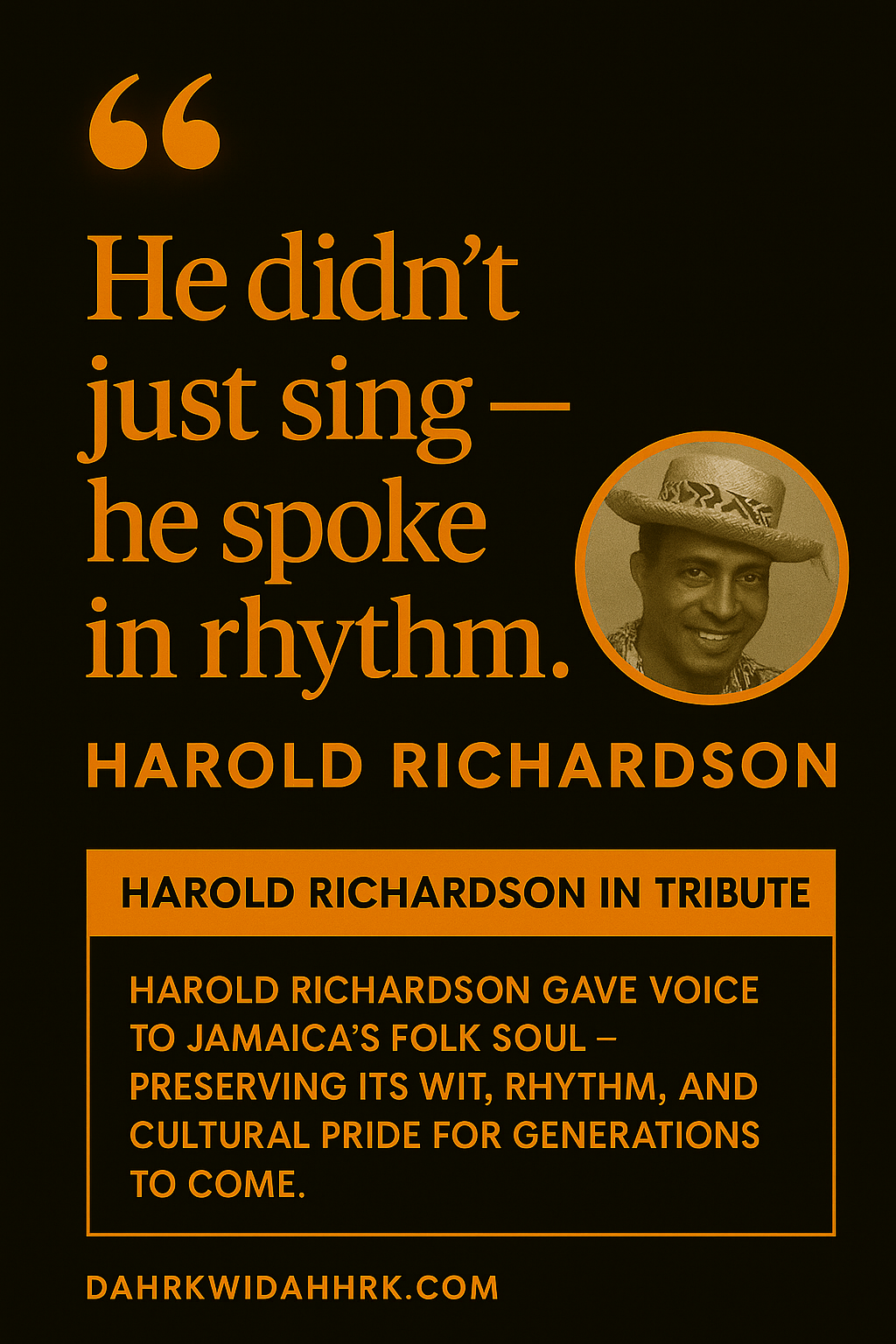
“He didn’t just sing — he spoke in rhythm. That phrasing became the base for generations of Jamaican vocalists.” — Bilby, 1995
3. A Template for Rural Storytelling in Urban Sound
Harold Richardson’s impact also lies in his ability to translate rural Jamaican realities into a format that urban and even international audiences could understand and enjoy. His themes — relationships, mischief, social inversion — made him relatable across classes and regions, giving mento universal appeal without diluting its roots.
This established a template later mirrored by:
- Ska singers (like Derrick Morgan and Justin Hinds)
- Reggae griots (like Toots Hibbert and Burning Spear)
- Dancehall storytellers (like Professor Nuts and Yellowman)
4. Elevating the Ticklers and Ensemble-Based Performance
Richardson often performed with The Ticklers, one of the most well-known early mento groups. These performances helped popularize the ensemble-based acoustic setup — with rumba box, banjo, guitar, and percussion — as a standard format for mento.
This normalized the aesthetic of the mento band, which later influenced ska’s brass sections and reggae’s rhythm guitar-and-drum pairing.
5. Sustaining Mento Through Recording Longevity
Harold Richardson’s recordings remain among the most reissued and anthologized mento tracks today. His presence in collections such as Mento Madness: Motta’s Jamaican Mento 1951–56 has helped:
- Keep mento visible in the digital age
- Support scholarly and cultural revitalization projects
- Inspire neo-mento acts like The Jolly Boys and Blue Glaze Mento Band
His impact is also practical — he provided a listening library for future generations.
Conclusion
Harold Richardson’s impact on mento music is both foundational and far-reaching. He wasn’t just a singer — he was a vocal storyteller, a cultural anchor, and a transmitter of folk knowledge. Through his recordings, his voice gave structure to Jamaica’s emerging musical identity, and his style provided the blueprint for lyrical play, timing, and tone that echoes through every generation of Jamaican music.
Richardson’s legacy is not just in what he recorded — it’s in how he made mento matter, and how his presence ensures folk culture is remembered, not erased.
References
Various Artists. (2004). Mento Madness: Motta’s Jamaican Mento 1951–56 [Compilation]. V2 Records.
Bilby, K. M. (1995). Jamaica’s Mento Tradition: Rediscovering the Roots of Reggae. Caribbean Quarterly, 41(1), 1–20.
Manuel, P. (2006). Caribbean Currents: Caribbean Music from Rumba to Reggae. Temple University Press.
Henke, J., & Marshall, W. (2001). Reggae Routes: The Story of Jamaican Music. Ian Randle Publishers.
Smithsonian Folkways. (n.d.). Mento: Jamaican Folk Music. Retrieved from https://folkways.si.edu/
Alleyne, M. (1997). Folk Music and Social Consciousness in Jamaica. Caribbean Cultural Studies, 12(2), 45–60.