
What is the Legacy of Lord Fly in Mento Music?
Lord Fly, born Rupert Lyon, is widely recognized as the first Jamaican artist to be professionally recorded, placing him at the very roots of Jamaica’s musical lineage. More than just a vocalist or bandleader, his legacy lies in how he preserved, popularized, and legitimized mento during a pivotal time in the island’s cultural evolution. As a bridge between oral tradition and documented history, Lord Fly’s contributions echo far beyond the grooves of his early 78 RPM records.
This article examines the depth and dimensions of Lord Fly’s legacy, revealing his impact not only on mento music but on the entire arc of Jamaican cultural expression.
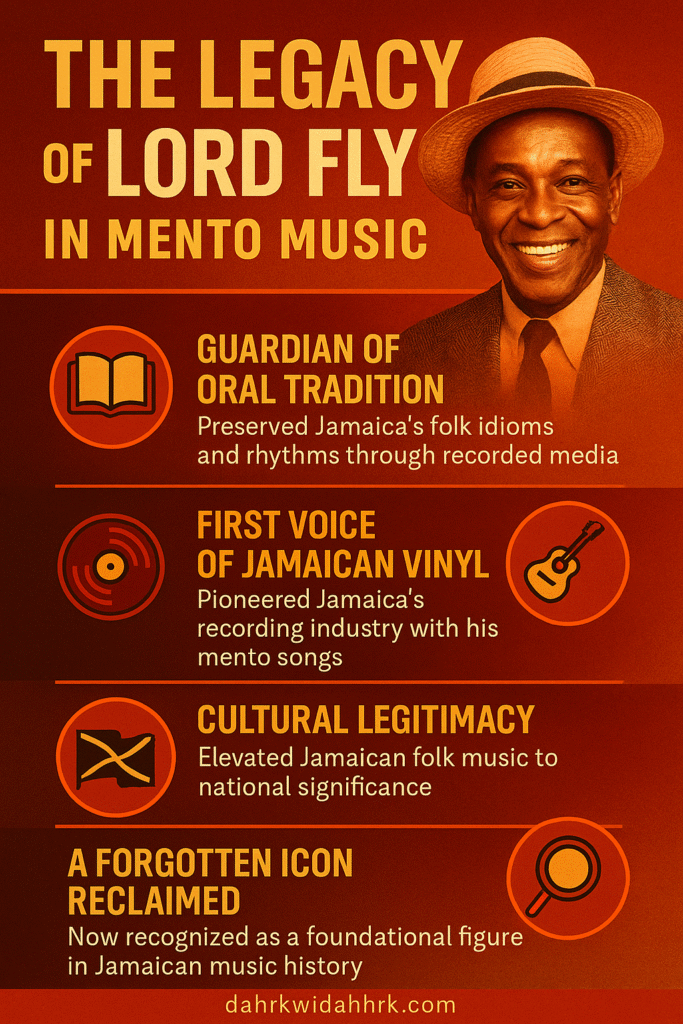
1. Lord Fly as the Guardian of Oral Tradition
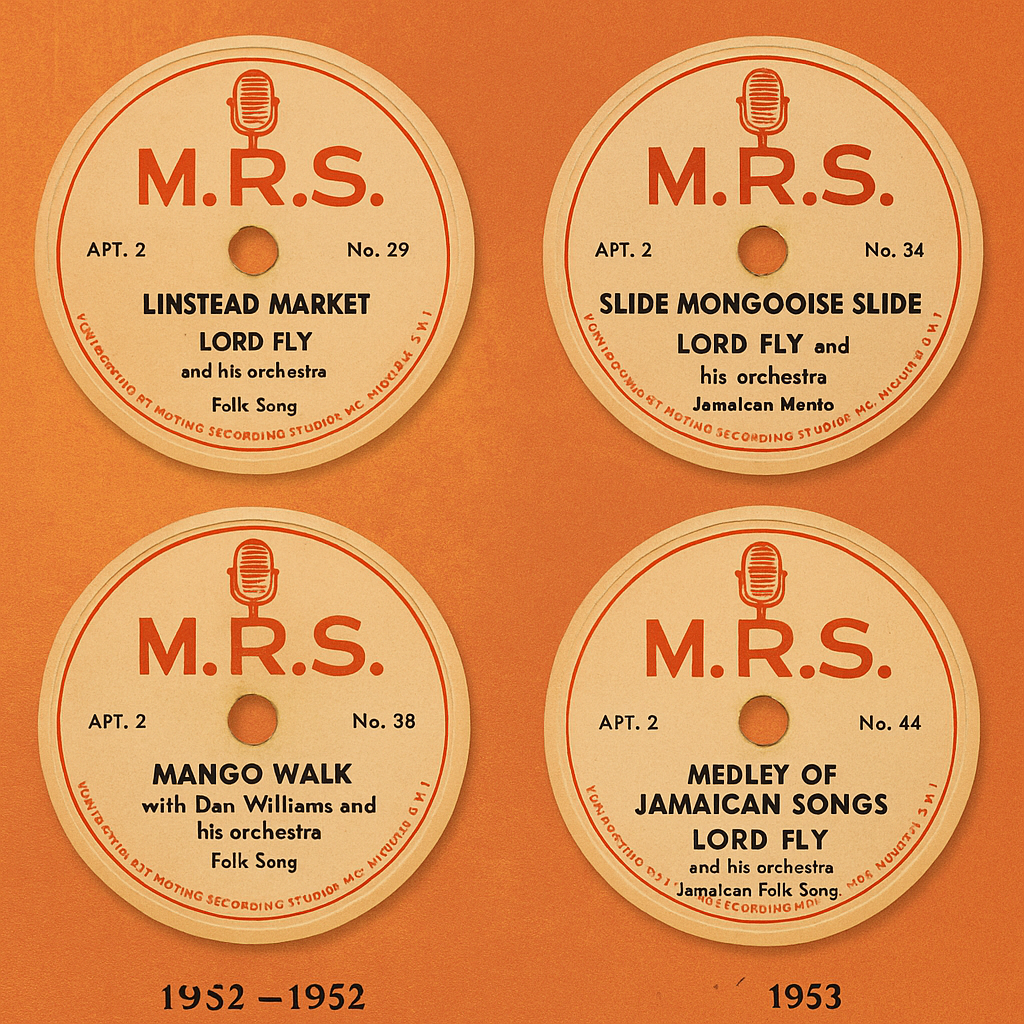
In the pre-reggae era, Jamaican music was largely oral, local, and live. Songs were passed down by memory, changing from community to community. Lord Fly’s 1951 recordings with Stanley Motta’s MRS label were more than commercial milestones — they were acts of cultural preservation.
“Lord Fly captured the musical memory of a people before it disappeared under modern influence.” — Bilby, 1995
His legacy begins with the formal documentation of Jamaica’s folk idioms, including proverbs, market cries, riddles, and dance rhythms. Songs like Linstead Market and Mango Walk were not just entertainment — they became sonic archives.
2. The First Voice of Jamaican Vinyl
When Lord Fly’s mento songs hit wax, Jamaica had no recording industry to speak of. His records, pressed at Motta’s Recording Studio, represented a shift from ephemeral performance to permanent preservation.
This placed Lord Fly in a historic position:
- He was the first voice that the world would hear as “Jamaican music.”
- He inspired future producers to build studios that would later birth ska, reggae, and dancehall.
- His recordings circulated among diaspora communities, planting seeds of cultural connection abroad.
In many ways, Lord Fly’s legacy is infrastructural — he helped build the platform that later legends would stand on.
3. A Mento Blueprint for Future Genres
Lord Fly’s phrasing, storytelling, and rhythmic approach directly influenced the structure of:
- Ska vocals and horn phrasing
- Reggae call-and-response patterns
- Dancehall MC lyricism and cadence
His delivery balanced humor with critique, dance with discourse, and folk wisdom with performative flair — all traits that would evolve into the lyrical backbone of Jamaican music.
“He taught the island how to sing its own story, in its own language, for the first time on record.” — Manuel, 2006
4. Cultural Legitimacy for Jamaican Expression
Before Lord Fly, Jamaican folk music was often viewed as low-class, informal, or colonially irrelevant. His recordings helped transform mento into something culturally and nationally significant. By putting patois, hand-crafted rhythms, and rural stories onto physical records, he:
- Elevated folk idioms into national memory
- Proved the value of Jamaican culture in its own voice
- Laid emotional groundwork for the cultural pride in reggae and Rastafari to follow
His legacy is also one of validation — he showed that Jamaica didn’t need foreign polish to be powerful.
5. A Forgotten Icon Reclaimed
Despite his foundational role, Lord Fly was largely forgotten by the time reggae exploded globally in the 1970s. However, his legacy has been reclaimed in recent decades through:
- Archival reissues on Smithsonian Folkways and Trojan Records
- Academic work by Kenneth Bilby, Peter Manuel, and others
- Inclusion in mento retrospectives and heritage projects
Today, music educators, cultural historians, and folklorists cite Lord Fly as one of the most important figures in pre-independence Jamaican music.
Conclusion
Lord Fly’s legacy in mento music is foundational, enduring, and culturally transformative. He wasn’t just the first — he was a visionary custodian of tradition, capturing the soul of a people at a time when few others thought it was worth preserving. Through rhythm, rhyme, and record, he turned fleeting performance into permanent heritage.
In every ska beat, reggae riff, and dancehall lyric that carries a folk echo — Lord Fly is there, still flying.
References (APA Style)
- Bilby, K. M. (1995). Jamaica’s Mento Tradition: Rediscovering the Roots of Reggae. Caribbean Quarterly, 41(1), 1–20.
- Manuel, P. (2006). Caribbean Currents: Caribbean Music from Rumba to Reggae. Temple University Press.
- Henke, J., & Marshall, W. (2001). Reggae Routes: The Story of Jamaican Music. Ian Randle Publishers.
- Smithsonian Folkways. (n.d.). Mento: Jamaican Folk Music. Retrieved from https://folkways.si.edu/
- Hope, D. P. (2006). Inna di Dancehall: Popular Culture and the Politics of Identity in Jamaica. University of the West Indies Press.
- Motta’s Recording Studio. (1951). Lord Fly with Dan Williams Orchestra [78 RPM series].